
For any facility handling hazardous liquids, spill protection needs to be high on the agenda. If you’re in the petroleum, chemical or utility industries, chances are you’ve come across the term “containment berm.” But what are they, how are they used, and what are the best ways to ensure you are following the regulatory guidelines for their use.
Take a look at our guide to spill protection equipment as we examine what an oil spill berm is and how it can help your business.
What Is a Spill Containment Berm?
What is a berm exactly? A berm is rather like a dam — a structure designed to prevent the escape of a liquid. Businesses deploy these berms to limit or prevent the contamination and damage associated with oil or chemical spills. Solutions are built with highly durable materials that effectively contain spilled substances, protecting public health as well as preserving the local environment.
A spill containment berm is an effective and affordable option for the secondary containment of hazardous liquids in order to prevent the pollution of soil and water.
Containment berms are commonly used to for the protection of fuel trucks, any oil-filled equipment, fuel tanks, truck washing decks, and any item that may leak hazardous liquids. They are typically made from a heavy duty 30 mil chemical and fuel resistant fabric. These berms are lighter in weight compared to metal containment berms.
What Are Containment Berms Made Of?
Spill containment berms are typically made from a heavy duty 30 mil chemical and fuel resistant fabric. These berms are lighter in weight compared to metal containment berms.
According to wikipedia, “fabric berms are the preferred modern technique for spill prevention and containment over the older methods of catch basins which can leak, often cannot be moved, or easily cleaned.”
But as the old adage goes, buyer beware. There are options on the market for cheaper PVC fabric for spill containment which can break down when they come into limited contact with any petroleum-based chemical.
So make sure your fabric has both puncture resistance and high tear strength like you find in the popular XR-5 or Cool Guard fabrics.
How Are Spill Containment Berms Used?
Containment berms should always be deployed on a flat surface free from debris and sharp objects. If the berms are going to be used frequently, you should also make sure to use Ground Mats to lay underneath the berm and Track Mats, which help protect the berm from tire abrasion. (All our berms come with bulkhead drain plugs and free repair kits.)
How to Put in Place the Right Oil Spill Protection
There are a number of different factors to consider when you select the right spill protection for your facility:
- Dimensions
What area do you need your spill berm to cover? How much volume of spill containment do you need?
- Spill composition
Which substances do you need to contain? Make sure that the berm you choose is rated to handle these substances — for example, is the berm rated for oil or corrosive substances?
- Regulatory requirements
Does the berm meet federal and local regulations in your area? All of Chemtech’s containment products are designed to meet federal containment regulations.
- Applications
Do you need a spill containment berm simply for the loading and offloading of relatively lightweight drums, or do you need a more heavy-duty solution that a vehicle can drive onto and off of?
- Deployment
Do you want a berm that team members can deploy swiftly with minimal prior training? Are your teams comfortable with using a more complex solution?
- Special features
Are there any other features you need for your spill containment berm? For example, custom valve assemblies or automatically-raising walls that respond immediately to spill incidents.
Types of Spill Containment and Protection Berms
There are many different types of spill protection berms available for your facility, as well as other associated products that support similar aims. Take a look at some of these different options.
- Wall berms
Wall berms have rigid walls on the left and right sides, which rise automatically in the event of a spillage. These sides are connected via a flexible front and back end. This means vehicles can be driven onto and off of the berm — via the front and back end — without damage to the berm itself. Different sizes are available, designed to support various applications onsite. If you regularly need to protect your tanker vehicles from spills, this option may be suitable for you.
- Foam berms
Foam berms feature flexible berm walls on all four sides. These walls can be driven over by vehicles from any angle without damage. While foam berms are available with the same area as the larger wall berm models, the walls are not as high — this means they can contain only around a quarter of the spill volume.
- Snap-up berms
Snap-up berms feature rigid, 12-inch-high walls on all four sides. Once erected, these walls cannot be driven over by vehicles without damage. Teams need to assemble the snap-up berm utilizing grommets that are found at six-inch intervals along the berm’s skirting. Be aware that the walls need to be manually erected and disassembled, and so will not rise automatically like those of the wall berm discussed above.
- Throw ‘n’ go berms
Throw ‘n’ go berms are so named because they are easy to deploy, empty, and remove. They feature none of the rigid parts associated with other types of berms — such as wall berms and snap-up berms — and so they can be driven onto or over at any angle with no damage to the berm itself. Walls extend as high as 12 inches from the surface upon which the berm is mounted, providing extra spill containment volume compared to foam berms and other solutions. Track mats can be added to the berm to offer further reinforcement when used with trucks and other heavy-duty vehicles.
- Spill pans
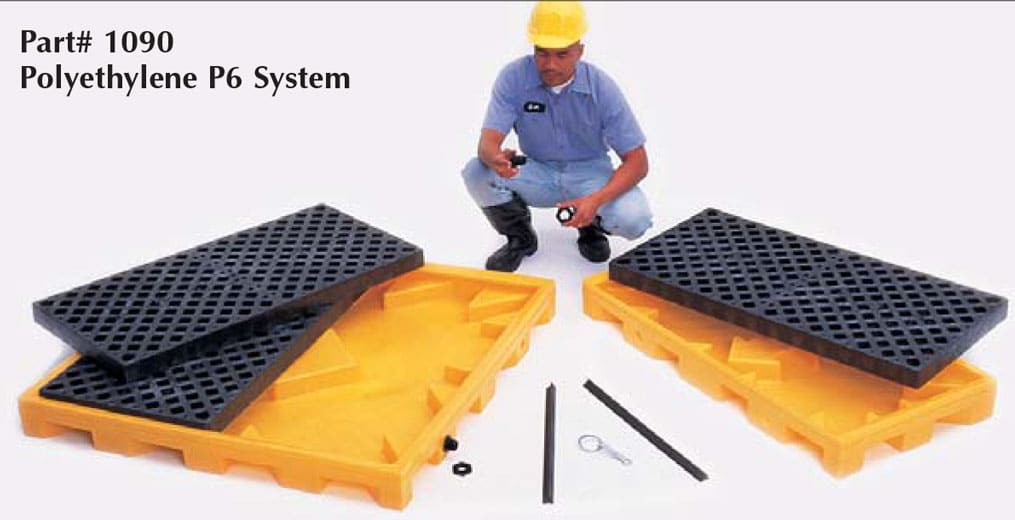
Spill pans are among the easiest and most convenient spill protection berms to deploy. Unlike snap-up berms and other solutions, this type of product requires no setup. Various sizes are available, covering a broad range of areas — from 25 square feet up to 750 square feet. However, Chemtech’s spill pans all feature the same three-inch foam logs along each side, which means they do not offer the same containment volume as a wall berm or snap-up berm can, even at larger configurations. These foam logs can be driven over from any angle with no damage to the berm itself.
- Onion tanks
Onion tanks work a little differently than standard spill berms. They are not designed for direct spill containment and instead operate as soft, self-supporting water receptacles. These tanks are so named because of their bulbous shape and feature roll top, zipper top, and open top designs depending on your needs. Different sizes are available up to 5,000 gallons. Other sizes are provided up to a made-to-measure basis, giving up to 15,000 gallons of storage, although the solution is not suitable for corrosive or hazardous forms of waste.
- Pillow tanks
Like the onion tank, pillow tanks are not traditional spill containment berms and are instead intended as flexible fabric water storage tanks. These solutions are built to handle both potable and non-potable water but are not suitable for other types of liquid storage. Pillow tanks represent a more versatile option than onion tanks, as they are available in sizes as small as 100 gallons up to larger 20,000-gallon solutions. Chemtech can also provide custom valve assemblies according to your specific requirements.
What Are the EPA Guidelines for Containment Berms?
If you store or use large quantities of petroleum products, you already know that the EPA Spill Prevention, Control, and Countermeasure (SPCC) guidelines require you to have a plan in place to contain a spill and to prevent the pollution of our natural resources.
Chemtech Spill Containment Berms
Chemtech International offers a variety of spill containment berms. We have some amazing drive through berms that require very little set up. Our Throw N Go berm and Throw N Snap berm can be deployed in less than 30 seconds!
Containment berms should always be deployed on a flat surface free from debris and sharp objects. If the berms are going to be used frequently, it is recommended that customers use our Ground Mats to lay underneath the berm and our built-in Track Mats, which help protect the berm from tire abrasion. All our berms come with bulkhead drain plugs and free repair kits.
Chemtech offers a variety of spill containment berms. We have to drive through berms that require very little set up and can be deployed in less than 30 seconds! All our berms come with bulkhead drain plugs and free repair kits. To learn more about our spill containment berms, fill out our contact form to talk to one of our representatives. With plenty of options out there, it pays to take your time over your decision. Regardless of the specific needs of your business and your facility, you are sure to find a piece of spill protection that meets these needs or even goes above and beyond them. Just remember to take your time and to choose carefully. Different industrial applications call for radically different types of spill berm, and you may even find that another solution is more suited to your needs. Use the criteria listed above to better understand your requirements before you make your selection.
About Author

Neel Daphtary
Neel Daphtary is the President of Chemtech International. He oversees sales, distribution and business development. He excels at helping pharmaceutical and manufacturing firms find the right processes and environmental solutions. Neel is an active member of Global Philadelphia, an organization committed to community development in PA.




Have Any Questions Or Comments?
Call Us For Help!
888-709-8070