
Have you ever wondered why dairy effluent is consistently ranked as one of the hardest industrial wastes to treat? It is a question that frustrates everyone from the guy running a small cheese shop to the facility manager at a massive yogurt plant.
The reality is that wastewater in dairy processing isn’t just dirty water. It is a nasty “cocktail” of dissolved milk sugars, complex proteins, and heavy fat loads that creates a nightmare for standard filtration systems.
High concentrations of Fats, Oils & Grease (FOG) in dairy industry effluents don’t just clog your pipes; they coat the very bacteria we need to clean the water, essentially suffocating the process before it starts.
This guide breaks down exactly how to manage these greasy pollutants to protect your infrastructure and hit your discharge permits every single time.
First, we need to understand why it causes so much trouble.
What Makes Wastewater in Dairy Processing Unique and Difficult?
The main issue here is the sheer organic intensity of the waste. Why does the milk-to-waste ratio result in such massive Biochemical Oxygen Demand (BOD) levels?
Because milk is incredibly nutrient-dense. Even a small spill of raw milk into the drain can skyrocket your organic load, demanding a massive amount of oxygen to break down. This puts a strain on your treatment plant that typical municipal systems just aren’t built to handle. Adding to the complexity is the way equipment is used and cleaned.
How do hot-water cleaning cycles (CIP) impact the physical state of FOG in dairy industry waste? To understand this simply, we need to keep in mind that the temperature swings are brutal and that’s why hot water melts the fats, allowing them to flow deep into your system, but as soon as that water cools in the pipes, those fats solidify into concrete-like blocks.
Much like the challenges in wastewater treatment in the meat processing Industry, dairy waste is packed with these stubborn proteins and fats that demand a specialized approach rather than a generic solution. And when these fats solidify, the damage to your equipment begins.
How Excess FOG in Dairy Effluents Destroys Equipment
The destruction starts long before the water even hits the treatment plant. The physical reality of “fatbergs” in a dairy processing facility’s drainage system is a constant maintenance headache.
These blockages back up production lines and require expensive jetting to clear, costing you downtime and labor you can’t afford. The problem gets worse once it reaches your ecological and biological systems.
Fats prevent oxygen from reaching the microbes in your activated sludge tanks—when grease enters a bioreactor, it floats and forms a cap on the surface, or worse, it coats the bacterial floc itself. This prevents dissolved oxygen from transferring into the water, basically choking good microbes to death.
Then there is the issue of membrane fouling. Replacing expensive filtration membranes occluded by grease is a hidden cost that slowly but surely drives up your maintenance bills.
👉 For a broader view on managing livestock and processing runoff, see our Wastewater Treatment in Agriculture: The Definitive Guide.
Steps to Treat Wastewater in Dairy Processing
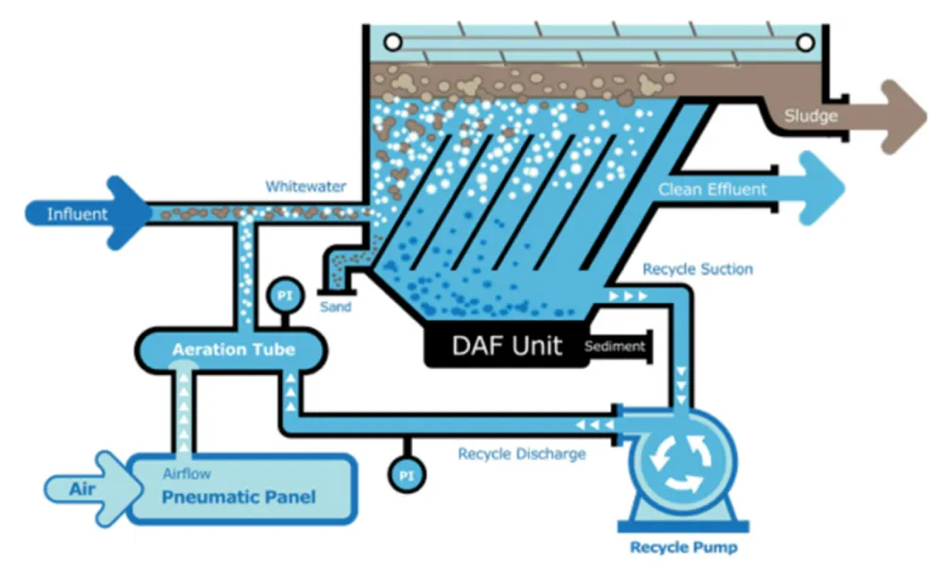
So how do we get the grease out before it causes this damage? How do micro-bubbles lift FOG or waste to the surface for skimming?
The answer is a simple (but not simplistic) industry-standard process known as Dissolved Air Flotation (DAF). Tiny air bubbles are injected into the wastewater. These bubbles attach to the fat particles, buoying them to the top where a skimmer scrapes them away.
Once the fat is physically removed, we turn to biological digestion to handle the dissolved organics. That means inducing special kinds of bacteria to “eat” the remaining lactose and dissolved proteins. Without this step, your effluent would still fail BOD tests, even if the water looks clear.
👉 For a look at how these stages fit into a larger facility design, read our article Activated Sludge Systems: Advantages and Disadvantages.
Pre-Treatment: The Secret to Managing FOG in Dairy Industry Waste
You might be tempted to skip the DAF and go straight to biology to save money, but that is a mistake. Removing grease from the biological tank is the only way to prevent a system crash. Remember, your biological tank isn’t designed to digest a stick of butter; it is designed only to “polish” water.
So, if you skip the “sacrificial” pre-treatment step, you are setting your systems up for failure.
To make the DAF unit work efficiently, we often use coagulation and flocculation. By adding specific chemicals, we can clump tiny, emulsified fat globules into larger masses that are much easier to filter out.
This chemical assistance is often the difference between a compliant system and a clogged mess.
Monitoring the Health of Water Used in Dairy Processes
Even with the best equipment, you can’t manage what you don’t measure. You’re basically flying blind if you aren’t checking your FOG and TSS levels every shift. Relying on a monthly lab result means you are reacting to problems that happened weeks ago, which is far too late to save a crashing system.
We strongly recommend using Chemetrics Water Test Kits to get instant, actionable data on your effluent quality right on the plant floor.
Knowing the accurate amounts of oxygen, acids, bases, ammonia and other compounds and gases in various water systems allows you to adjust your chemical dosing or aeration in real-time.
👉 See why data is your best defense in The Ins and Outs of Wastewater Analysis.
Eliminating FOG with Specialized Products

Sometimes, mechanical or chemical removal options aren’t enough, especially for grease that clings to your pipes. In such cases, adding “fat-eating” bacteria can help clear out your grease traps and sewer lines.
Bio-augmentation introduces lipase-producing bacteria that specifically target and break down long-chain fatty acids, turning them into simpler compounds that wash away.
We have specifically engineered our full range of Chemtech wastewater treatment products for the tough organic loads of the food industry. These products work wonders unlike generic bacteria, which die off when hit with the high-strength dairy and meat biowaste.
Our lab-tested bacterial products focus on quickly reducing the volume of greasy sludge, drastically lowering your off-site disposal costs and keeping your plant running smoothly.
At Chemtech, we understand that the dairy industry moves fast (contrary to public perception).
And your waste management efforts need to keep up to the pace of everyday operations. We don’t just provide products; we also offer the technical support to help you put in place the best water treatment and waste management processes.
So if you are ready to start fighting sludge and grease more efficiently, get in touch with our team right away!
About Author

Neel Daphtary
Neel Daphtary is the President of Chemtech International. He oversees sales, distribution and business development. He excels at helping pharmaceutical and manufacturing firms find the right processes and environmental solutions. Neel is an active member of Global Philadelphia, an organization committed to community development in PA.

Have Any Questions Or Comments?
Call Us For Help!
888-709-8070